
Krampus must stay outside – but what about St. Nicholas?
Not all parents want St. Nicholas to visit the kindergarten, often because of their own experiences. However, a lot has changed in recent years. He hardly acts as an educator anymore.
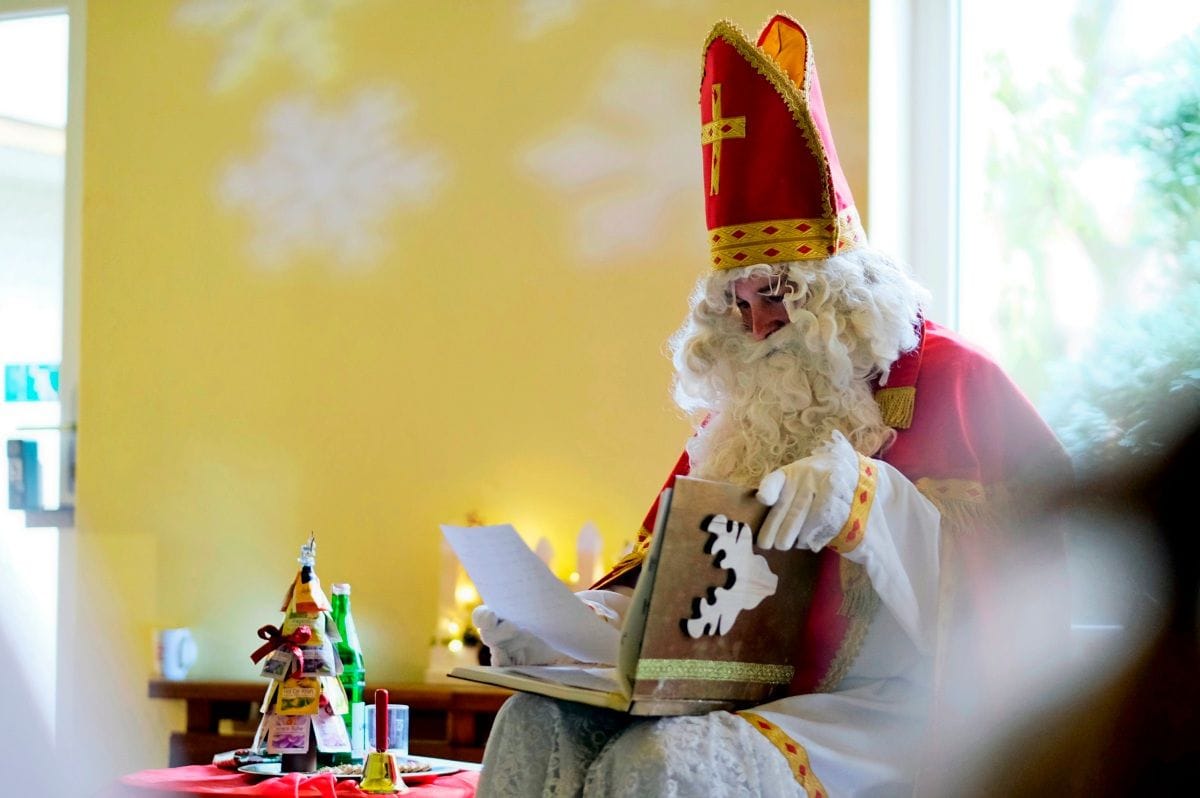
Every year in December, the debate about St. Nicholas in Austrian kindergartens resurfaces. The topic is particularly controversial in Vienna—especially when elementary educational institutions speak out against his visits.
But who actually decides whether St. Nicholas distributes chocolate and mandarins locally? And is his visit still appropriate in this day and age?
It is “a bit difficult” these days, says René Traun. He is the chairman of the non-profit association Wiener Kramperl and currently works as St. Nicholas in Vienna. He attends Christmas parties, makes house calls, and visits kindergartens and schools. Nowadays, many parents no longer want him or his colleagues to come to educational institutions. "Some kindergartens simply don't dare to do it anymore. But we are trying to revive this custom."
Many families are simply no longer familiar with the tradition, says Traun. Visits from St. Nicholas are mainly a tradition in Austria and Germany; others don't understand it. “You have to explain it to them. After all, it doesn't matter what cultural background a child has; when St. Nicholas comes, everyone's eyes light up.”
Kindergartens decide
Kindergartens decide for themselves how to celebrate St. Nicholas Day. According to the responsible municipal department, St. Nicholas celebrations are generally held in Vienna's municipal kindergartens. “This traditional festival conveys many important messages in today's world, including humanity, appreciation, charity, and solidarity, in the spirit of peaceful coexistence,” is the reasoning given. Celebrating festivals is of “great importance” in the city's kindergartens. The children are involved in the preparations and during the celebrations, gaining “valuable experiences in the community.” Recurring celebrations and living traditions give the youngest children orientation in the annual cycle and a feeling of security and comfort.
However, St. Nicholas does not actually attend every celebration around December 6. “There are many ways to celebrate,” says MA 10. Sometimes someone from the team or the children themselves dress up. Or St. Nicholas is not seen at all, but leaves traces and gifts behind.“ Nikolo René Traun relies on the element of mystery: ”I always plan in advance where I can change,“ he says: ”I don't want the children to see me without my costume, because then the moment is lost."
Angels instead of Krampus
The city council is convinced that children feel safer when someone they know takes on the role of St. Nicholas. In any case, St. Nicholas comes alone in Vienna, according to the office of City Councilor for Education Bettina Emmerling (Neos). Krampus and the harsh educational methods represented by his hairy companion are not supported.
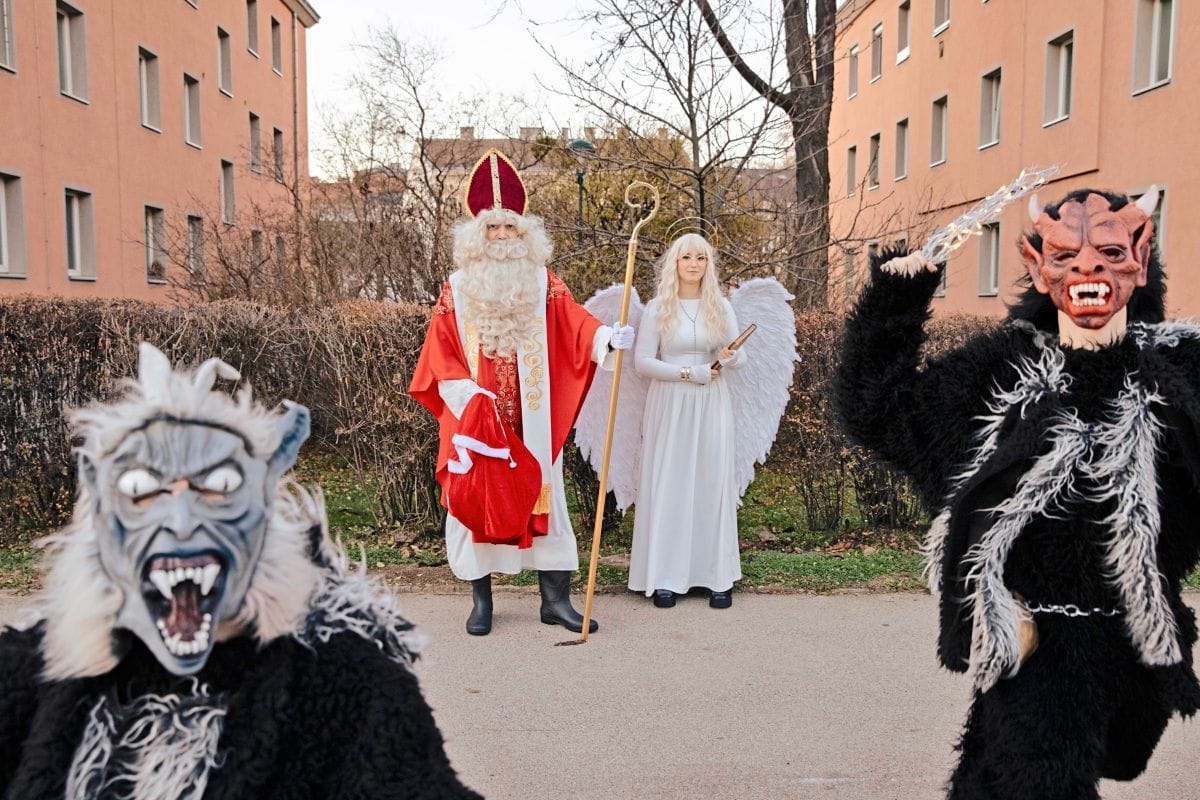
Traun also does not have Krampus with the youngest children. If he has an escort in kindergarten or on home visits, it is an angel. Krampus is only allowed to attend events where there are only children of an age who understand that there is a person behind the mask. “For example, when we are booked for Christmas parties and children are present, the Krampus take off their masks at the end so that everyone can see that it is just a costume and there is no need to be afraid.”
Krampus is one of the reasons why parents have negative memories of St. Nicholas' visit and want something different for their children, says family counselor Claudia Toth. Added to this is the way these appearances sometimes took place: “In the past, visits from St. Nicholas were often associated with fear. Children had to recite poems or justify whether they had been good.” This is no longer appropriate and does not fit in with what many parents understand modern parenting to be.
“Important part” of Christianity
Rather, it is about conveying values: compassion, helpfulness, and community. So the discussion should not be about whether St. Nicholas is allowed to come, but about what he stands for, says Toth. St. Nicholas is a calm, positive figure who stands for warmth, responsibility, and solidarity.
Values are also used to argue for St. Nicholas visits in federal politics. “St. Nicholas Day is part of our culture and an important part of Christianity,” says Nico Marchetti, secretary-general and education spokesperson for the ÖVP. Customs and Christian values provide guidance and strengthen community spirit. In their government program, the People's Party, SPÖ, and Neos have stipulated that even kindergartens should teach “the Austrian way of life and traditional celebrations, as well as our liberal understanding of democracy.” However, no examples of this are given.
No “emergency educational aid”
There should be room for cultural diversity in kindergarten, says Silvia Kumpan-Takacs, SPÖ spokesperson for elementary education and a trained elementary educator. The legend of St. Nicholas could “definitely be part of educational offerings in the areas of language development, social and emotional competence, ethics, and society.” As far as visits to kindergartens are concerned, educators would take the children's fears and uncertainties into account. It is important that “St. Nicholas should not be misused as an educational aid or as an extension of political agendas.”

Traun doesn't do that either. He is briefed by the teachers before his visit. With a list of the children's names and what went particularly well. “What I don't like are negative things. I'm not there to admonish, but only to highlight the positive and praise.” And then he distributes the bags. These are put together by the kindergartens. St. Nicholas thinks this is a good idea, as he would “definitely put too many sweets in them.”
Ultimately, it is up to the kindergarten to decide whether to have a visit, says Neos education spokesperson Martina Künsberg Sarre. She also believes that “social and cultural celebrations have a long tradition in kindergartens – including St. Nicholas Day.” This allows “many important messages to be conveyed,” such as social cohesion and mutual care.
Preserve “under all circumstances”
And what does the opposition think? St. Nicholas Day should be preserved “under all circumstances,” says FPÖ education spokesperson Hermann Brückl. The visit strengthens children's understanding of local culture and conveys values such as helpfulness, charity, and gratitude. It also promotes social skills because children learn to celebrate together: “With St. Nicholas celebrations, we are not dividing society, but promoting community.”
When St. Nicholas visits kindergarten, the visit must be “child-friendly and without fear,” says Barbara Neßler, spokesperson for elementary education for the Green Party. It is important that values such as “friendliness and solidarity are the focus—not pressure or moral judgments.”
Shouldn't, but can
Even for Niko Alm, founder of the Laicism Initiative and former politician, St. Nicholas' visit to kindergarten is acceptable. “St. Nicholas shouldn't come, but he can,” he summarizes his position. "For me as an atheist and non-denominational person, it is legitimate to uphold traditions. Many traditions come from religion, but that doesn't have to be a problem for the separation of state and religion."
There is a difference, he says, between a priest dressed as St. Nicholas coming to hear a little confession or even threatening punishment, and simply giving gifts, combined with the rhetorical question of whether the children have been good. For Alm, “St. Nicholas is far down the list of problems raised by the relationship between religion and the republic.”